
Read Fremont County Recorded Conveyances
Every Fremont County land instrument that reaches the Clerk/Recorder becomes part of the public record of conveyance. A deed names the parties and describes the land. It also fixes the transaction's place in the county's official sequence. Form and language matter here. Different instruments transfer different interests and carry different promises from seller to buyer.
| Deed Type | What It Does | Common Use |
|---|---|---|
| Warranty deed | Conveys with stated title promises | Purchase transfer |
| Quitclaim deed | Conveys whatever interest is held | Family, estate, or title cleanup |
| Personal representative deed | Conveys under estate authority | Probate transfer |
| Trustee's deed | Conveys under trustee authority | Trust or foreclosure context |
| Tax deed | Conveys after statutory tax process | Tax-auction follow-up |
A deed rarely travels alone. Mortgages, releases, assignments, judgments, mechanics' liens, lis pendens, powers of attorney, leases, plats, water-right instruments, and fixture filings often surround the chain. None of them conveys ownership by itself. Any of them can still shape the answer to a property question.
Recorder Access Starts at the Fremont County Office
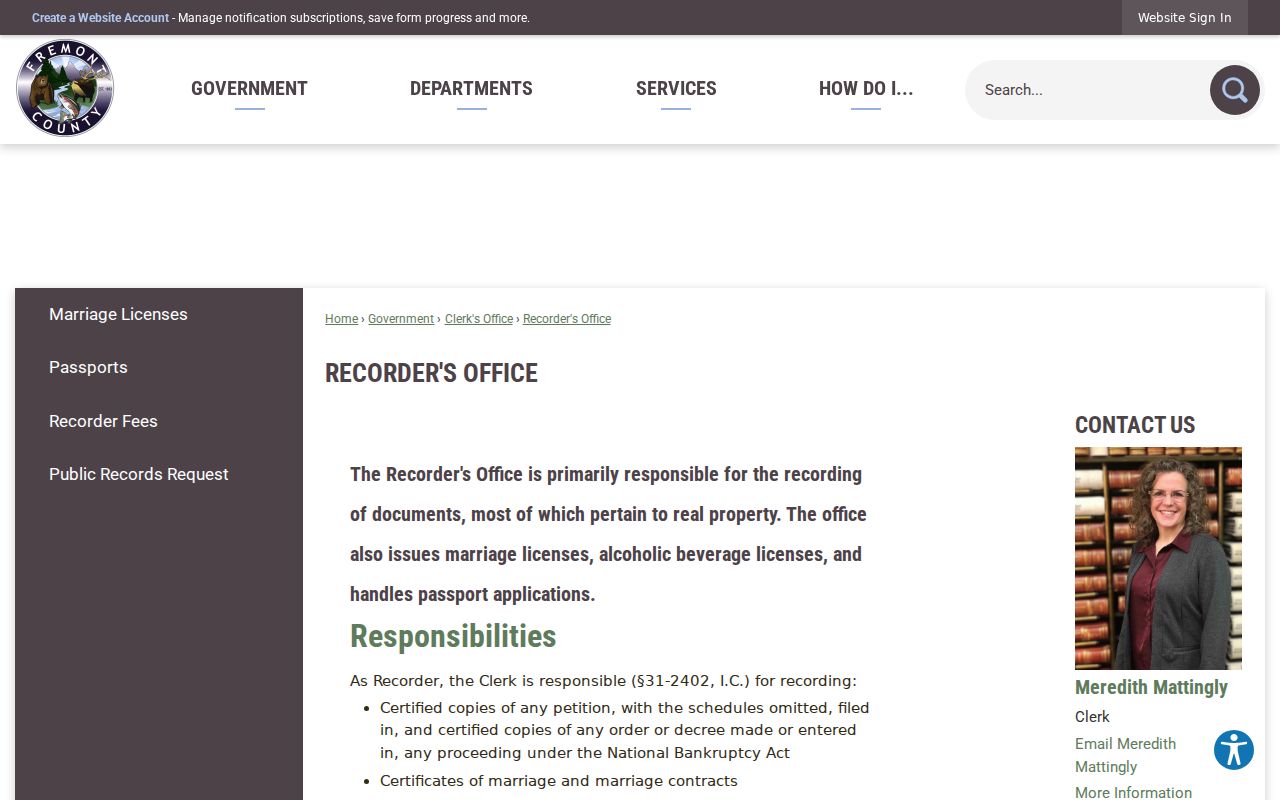
The Recorder's Office page lists the instrument categories the county records. It offers no public grantor-grantee index. It has no image viewer either. Access runs through the counter at 151 W 1st North in St. Anthony, the phone at 208-624-7200, or a written request. The official page itself displays the local instrument categories.
MapServer supplies parcel clues, but its owner label is not a recorded conveyance.
Fields for a Fremont County Deed Request
| Field | Purpose | Access |
|---|---|---|
| Grantor | Conveying party | Office request |
| Grantee | Receiving party | Office request |
| Date range | Narrow names | Office request |
| Book/page or instrument | Known deed | Office request |
| Parcel/legal description | Match land | MapServer then Recorder |
Say which instrument type you need and whether inspection, an uncertified copy, or a certified copy will do. The office publishes no web cutoff.
Walk the Fremont County Grantor-Grantee Chain
Start from the newest confirmed deed and work backward, matching the legal description at each step. The Assessor's owner label is a discovery clue only. It is never the chain itself.
- Locate the present owner's acquisition deed under that owner as grantee.
- Read its grantor, recording date, legal description, and locator.
- Search the grantor as a grantee to find the preceding acquisition.
- Repeat while noting estates, trusts, name changes, and parcel splits.
- Grantor
- The party conveying an interest.
- Grantee
- The party receiving an interest.
- Chain of title
- The linked sequence of recorded transfers.
- Book/Page vs Instrument Number
- The Recorder's locator for a recorded document.
Plats Anchor the Fremont Land Description
Plats give the Fremont land description its anchor. The South Fremont inventory counted 35 subdivisions and 581 mapped lots, including West Chester, River Rock Estates, Twin Groves, Salem Pines, and Fort Henry Estates. Treat those subdivision names as leads. They do not prove a lot is buildable. Gather the original, corrected, and amended plats, plus conditions, agreements, covenants, easements, drainage records, and survey references, then compare the deed language against the recorded plat and the current MapServer parcel layer.
Historic Fremont County Deed Records
Fremont County formed in 1893. The Recorder publishes no stated web cutoff or exact microfilm range, so ask the office directly about deed books, reverse indexes, microfilm, and predecessor-county references. The Idaho State Archives holds transferred material worth checking. The Teton Peak-Chronicle, published from 1904 to 1952, can surface probate, tax-sale, irrigation, townsite, and party-name leads. Newspapers point toward deeds. They never replace the recorded instruments themselves.
Liens and Court Records Around the Chain
Look at the instruments ringing a conveyance: mortgages, releases, judgments, mechanics' liens, lis pendens, leases, and water-right filings. Litigation in the picture changes the picture. For that, Idaho iCourt supports searches by party, business, or case number. Sealed and exempt cases are omitted, so an empty result does not prove no case exists.
Confirm Fremont County Recording Fees
The county's recording guideline cites Idaho Code §31-3205 and sets a general charge of $10 for the first page plus $3 for each later page. That rule answers few fee questions on its own. Certification, unusual document types, research time, mailing, or a changed schedule can all move the total. Before sending payment, describe the exact instruments sought. Ask the Clerk/Recorder to confirm the locator, page count, copy type, current amount, and accepted payment method. One caution: a recording fee for filing a new instrument is not the price of pulling an existing copy.
Subdivision Changes Complicate Deed Records
A deed chain can seem to dead-end when a tract was split, merged, replatted, or renamed. Keep every parent parcel number handy. Compare the legal description against both original and amended plats. Planning records may hold approval conditions, drainage material, development agreements, or road dedications that explain why later deeds describe the land differently. Recent county agendas name Sunrise Meadows, Fullmer Subdivision, Teton Tinsel Farms, and an amended Teton View plat, which shows why status matters. An agenda title is not a recorded plat. Ask whether the action was preliminary, final, amended, vacated, approved, or recorded. Then get the final instrument from the Recorder.
Use Every Fremont County Deed Access Route
With no county-hosted image index, call the Clerk/Recorder or visit the courthouse counter first. Give staff exact names. Include the parcel, legal description, date span, and instrument class. Broader requests can use the county's public-records form. The JustFOIA route works too, under the Idaho Public Records Act. Older work may need deed books, reverse indexes, or microfilm held locally. Ask the Recorder which series and years remain at the courthouse. Only then turn to the Idaho State Archives. The Fremont County District Library helps surface old names. So does the Teton Peak-Chronicle. Probate events, tax sales, roads, and townsite terms appear there too. Every such clue must lead back to a recorded or archival instrument.
Separate the Dates in a Fremont County Transfer
A recent transfer carries several dates. Each answers a different question. The deed may be signed one day, acknowledged another, and recorded later still. The Assessor updates its ownership roll on its own schedule. A current-year assessment draws on sales information from the prior calendar year. So a fresh transfer is not automatically evidence for the notice issued that same year.
| Date or status | What it can establish | What to verify |
|---|---|---|
| Instrument date | When the document says the parties acted | Signatures, acknowledgment, and legal description |
| Recording date | When the Recorder accepted it into the public sequence | Book/page or instrument number |
| Assessor update | When the assessment roll reflects a name | Compare the grantee with the recorded instrument |
| Tax-deed notice | A stated stage in a delinquent-tax process | Auction result, deed issuance, redemption, and later transfer |
When you ask about a recent Fremont County transfer, narrow the field first. Give the office the current and prior owner names, the parcel number, the street address, the legal description, a date range, the likely instrument type, and any related subdivision. Corrective instruments, trustee or personal-representative transfers, mortgages, and releases matter only insofar as they touch the question you are asking. A tax-auction notice marks a step in a process. It is not clean title.
Rural Fremont Instruments Reach Beyond a Conveyance
The Recorder's published list reaches well beyond deeds. Water-right judgments and general-adjudication notices sit alongside conveyances, liens, fixture filings, leases, and plats. Those surrounding documents matter most in rural work. A legal description, farm tract, irrigation reference, or subdivision file may point past the face of a single transfer. A later deed proves little on its own. It does not show that every mortgage was released or that each easement vanished. Read every incorporated reference with care. A legal description may point to a survey or plat. A plat may reserve roads, utilities, drainage areas, or other easements. A judgment or lis pendens may point to a court file. For court follow-up, iCourt is the right tool. It is subject to sealed and exempt record limits. The land instrument itself belongs to the Recorder. Entity names demand the same exactness as personal names. An LLC, corporation, partnership, trust, or family entity may show up in Fremont County property records. Keep its punctuation and spelling precisely as recorded. A Secretary of State entity filing can help explain the organization. Still, it is not proof that the entity owns the parcel. The conveyance and its legal description remain the public-record trail for that land. The parcel may have been divided or combined. Request the parent parcel, the final or amended plat, and the document that created the new description. The South Fremont inventory works well as a name index. Yet its 35 subdivisions and 581 lots describe only a mapped snapshot. The Recorder's final plat shows the sequence. The instruments recorded after it matter for a specific lot. Water-right and irrigation clues often hide under an adjudication caption or party name. They rarely sit under a street address. Hand the office the tract description and a narrow date span. Ask which index series covers that instrument class. That approach beats assuming one name search will reach every related record in the deed records.
Order a Fremont County Deed Copy
Start with the recording reference if you have one. Without it, provide party names, the parcel number, the legal description, the instrument type, and an approximate date. Say plainly what you want: to inspect the record, to receive a plain copy, or to obtain certification. A certification confirms the copy came from the custodian. It is not a title opinion. For broader county-held files, use JustFOIA. A known Fremont County deed copy should begin with the Clerk/Recorder instead. Idaho's public-records process works best when the request identifies an existing record rather than asking the office to research or build a new chain-of-title report.
Recorded, not guaranteed. Recording places a Fremont County deed in the public record; it does not validate every signature, cure every defect, or provide a title opinion.