
Trace Fremont County Former Owners from the Deed
The newest recorded conveyance matching the property's current legal description is the starting point. Fremont County publishes no online grantor-grantee index or deed-image viewer. A historical search therefore begins with the Clerk/Recorder. The office is reached by counter, telephone, or a focused written request. Each deed names its grantee. From that name, the chain steps back to the grantor. That grantor held the land before the transfer, deed by deed.
| Transfer Date | Grantor to Grantee | Deed Type | Book/Page or Instrument |
|---|---|---|---|
| Newest recorded date | Prior holder to present grantee | Copy the deed label exactly | Record the current locator |
| Next earlier recorded date | Earlier holder to that prior holder | Copy the deed label exactly | Record the prior locator |
| Continue backward | Repeat through each matched grantor and grantee | Note corrective, estate, trustee, quitclaim, or tax instruments | Preserve every cited book, page, or number |
| Point where county series changes | Carry the last verified names into older indexes | Check the actual instrument, not a secondary label | Ask which deed book, reverse index, or film continues the chain |
The right source depends on the era. A recent former owner calls for a Recorder request. Older county land and tax files may sit at the Idaho State Archives, and recorded or amended plats explain how lots changed. The Teton Peak-Chronicle ran from 1904 through 1952, and its predecessor began in 1899, offering names and event leads. Deed books and microfilm coverage vary. Ask the office to identify its earliest available index before you plan a visit.
Build a Fremont County Ownership-History Request
A precise request gives the Recorder's staff real anchors. It should not ask for an open-ended title search. Include the parcel number, current and likely prior owner names, street address, full legal description, a practical date range, deed type, and whether you want a plain or certified copy. When a lot came from a larger tract, add the parent parcel and the recorded plat name.
The Recorder handles a wide range of instruments. Deeds, grants, transfers, mortgages, releases, powers of attorney, leases, liens, judgments, water-right records, subdivision instruments, and probated wills all pass through the office. Ask for index references first. Then choose which instruments you need. If counter or phone access does not resolve the request, Fremont County offers a JustFOIA request route under the Idaho Public Records Act.
Recording guidance generally notes $10 for a first page and $3 for each later page. Confirm any unlisted charges by phone. Certification, delivery, payment, and turnaround should be checked with the office rather than assumed.
The county's Recorder page lists local instrument categories. It also shows the office's place under the County Clerk.
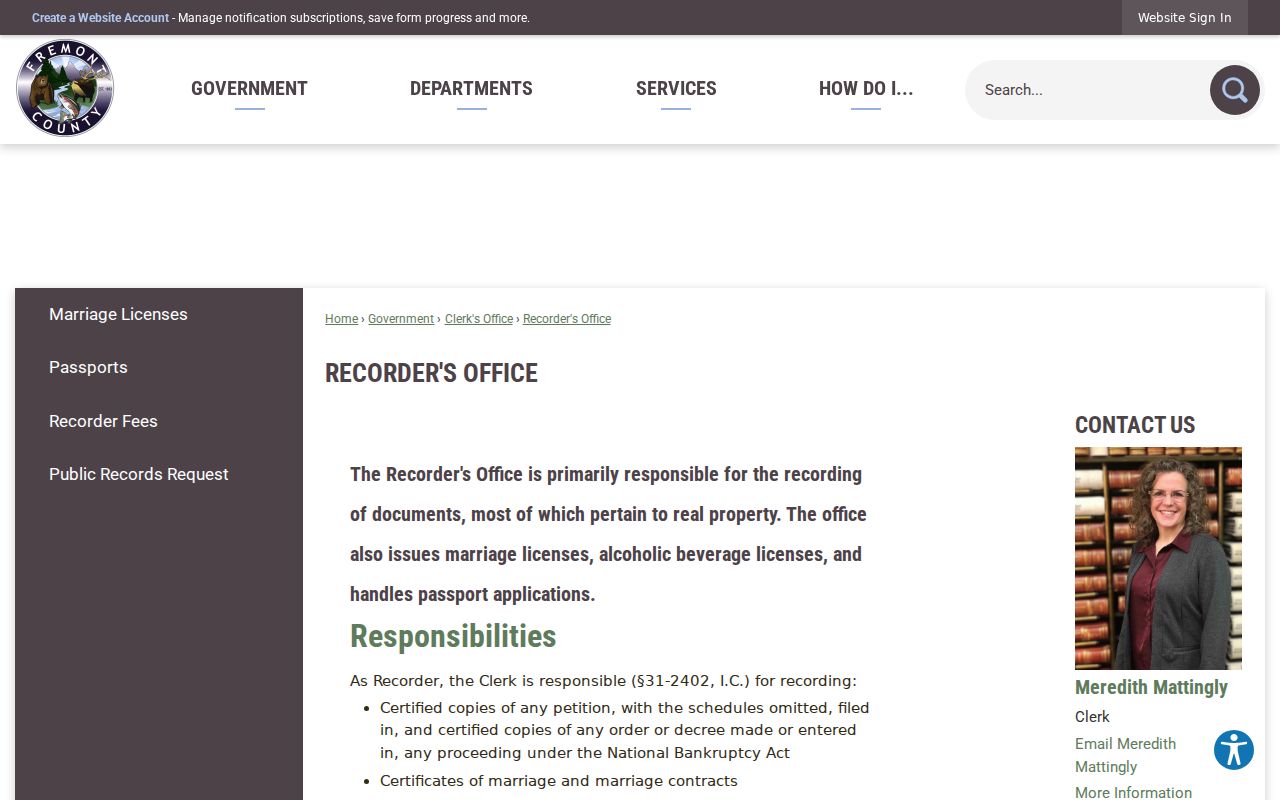
The Recorder page confirms the office route and the breadth of its records. It offers no searchable online chain. Proof of prior ownership comes from the documents themselves.
Note: A focused date range and an exact legal description work better than asking staff for every document ever tied to one address.
Fremont County Legal Descriptions Carry the Trail
A current address is only an orientation point. Earlier deeds may describe the same land as part of a farm, townsite block, acreage tract, homestead, or subdivision parent parcel. Record every detail exactly as shown. Lot and block, section-township-range, acreage calls, instrument numbers, book and page, and plat citations all anchor the trail.
Subdivision research matters in Fremont County. The South Fremont inventory counted 35 developments, 581 lots, and 323 improved lots. Named plats include Chester Estates, Twin Groves, River Rock Estates, Riverview Heights, and Fort Henry Estates. Those names work as search keys. The inventory is not proof a lot is current or buildable. Original, corrected, amended, and vacated plats can each reroute the record trail.
A complete plat check gathers the original drawing, every amendment or correction, approval conditions, covenants, road and utility easements, survey references, and vacation records. Planning approval and the recorded instrument are separate evidence.
Reconstruct Fremont County Previous Owners Backward
Read the chain in reverse. Start from one known deed. Each recorded transfer names the person or entity conveying the interest and the recipient. Then hunt that grantor as an earlier grantee. Repeat the method while matching the legal description, since a shared surname or a similar street address can point to the wrong land.
- Identify the newest deed for the current legal description and record its full citation.
- Read the grantor from that deed as the immediately prior owner.
- Search that grantor as an earlier grantee and compare the land description.
- Repeat through older index volumes, archived series, and referenced plats as needed.
- Grantor and grantee
- The party conveying an interest and the party receiving it.
- Chain of title
- The ordered run of instruments through which an interest passed.
- Reverse index
- An index arranged to find instruments through a named grantor or grantee.
- Warranty and quitclaim deeds
- Different forms of conveyance whose legal effect cannot be judged from the label alone.
Simple sequences break. Corrective deeds, personal-representative deeds, trustee's deeds, probate material, tax deeds, and boundary changes all interrupt a tidy chain. Recording dates can lag signing or closing dates.
Carry Fremont County Past Owners into the State Archives
Older records often outlive the county courthouse. The Idaho State Archives holds county and city government, land and property, court, tax, citizenship, and vital records. It fills gaps the county index cannot reach. Research requests are available. On-site work generally calls for an appointment about 48 hours ahead. Posted public hours run Wednesday through Saturday, 10:00 a.m. to 4:30 p.m.
Prepare the request carefully. Bring the modern parcel, every old legal description, known names, approximate years, and citations already found. Ask about finding aids and series coverage early. An older deed or tax roll may not have survived or reached microfilm, a catalog entry alone does not prove a transfer, and the Archives never replaces the current Recorder.
A 1904-1952 Fremont County Newspaper Opens Side Trails
The Library of Congress Teton Peak-Chronicle collection adds a rich layer to Fremont County former-owner research. The St. Anthony weekly spans 1904 through 1952. Its predecessor, the Teton Peak, started in 1899. Search grantor and grantee names alongside terms like tax sale, sheriff's sale, probate, townsite, subdivision, irrigation, and road. One notice can explain a whole transfer. A paper may reveal an estate, a sale announcement, a road shift, or a development name that the deed index never made plain.
Treat each find as a lead, though. It is not the operative conveyance. Names get misspelled. A published notice can even precede a sale that never closed. Carry every useful hit back to the recorded deed or the archival file before trusting it.
Use Fremont County Libraries as Discovery Points
Fremont County District Library branches in St. Anthony, Ashton, and Island Park are sensible stops for local context. The St. Anthony branch sits at 420 North Bridge. It offers public computers; its published telephone is 208-624-3192. The Ashton branch is listed at 925 Main with telephone 208-652-7280.
The libraries publish no branch-by-branch inventory online. Newspapers, obituaries, directories, vertical files, and microfilm years are not itemized there. Call first. The local Community History Archives search reaches back to around 1870. It can surface names and places, though its ownership and editorial custody deserve confirmation. FamilySearch catalog filters may also turn up deed, homestead, or mining leads. The exact Fremont County image coverage and access limits remain unverified.
User-contributed Fremont County genealogy material reports the county's creation from Bingham County in 1893. It also notes early settlement at Egin Bench. History like that shapes better queries. Still, each property fact needs confirmation in official deeds, plats, newspapers, or archives.
Know Where Fremont County Ownership History Stops
No verified web source gives a clean online cutoff year for Fremont County former owners. The honest boundary is record-series specific. Ask the Clerk/Recorder which earliest index can be searched at the courthouse. Ask whether older books or film require staff help. Ask how parent tracts, patents, homesteads, and townsite records are organized. When the county run ends, the State Archives may hold the matching land, court, or tax series.
The MapServer's historic ownership layer can orient a search. But it is not a historical deed index. A tax roll, newspaper notice, plat, or genealogy page may likewise name a past owner. That alone does not prove the transfer. The chain holds only as far as recorded evidence. Archival evidence must be joined to it without a gap.
No verified online cutoff. Fremont County publishes no confirmed web start year for its deed index. Ask about older deed books, reverse indexes, microfilm, and transferred archival series.
Lawful use. Research former Fremont County owners for house history, estate work, and property diligence. Never use historical names or addresses to stalk, harass, or harm a living person.